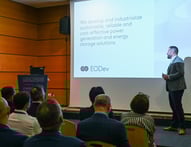



Road transport is the backbone of global logistics, and one of its biggest challenges when it comes to sustainability. As emission targets tighten and customer expectations evolve, logistics providers are under increasing pressure to rethink how goods are moved by road. In a series of interviews taken at Logiconomi 2025, we talk with executive leaders from KINTO Europe and Toyota Motor Europe about the challenges and opportunities in decarbonising road transport, and how a multi-path strategy is helping companies move forward.
The emission challenge: a systems perspective
From a systems theory perspective, logistics is a complex, adaptive system, where changes in one part (e.g., vehicle technology) ripple across others (e.g., infrastructure, regulation and customer behaviour). Road transport, which accounts for 70% of transport-related CO₂ emissions, is a critical subsystem.
Emmanuel Beaune, Head of Light Commercial Vehicles & Corporate Sales at Toyota Motor Europe, outlines the scale of the issue. “Today, 25% of CO₂ emissions are linked to the transport industry,” he explains, “and 70% of that share comes from road transport. As a carmaker, we have a great responsibility to make a substantial impact.”
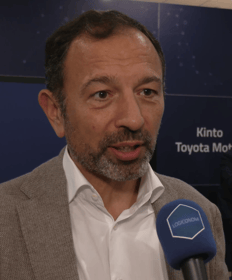
Didier Gambart, CEO at KINTO Europe, adds: “Our primary target is to reduce CO₂ emissions from light commercial vehicles and passenger cars, which account for roughly 25% of total road emissions. But we’re also working on hydrogen ecosystems to impact truck, train and other transport sectors.”
This reflects a shift from isolated interventions to ecosystem thinking, where partnerships and cross-sector collaboration are essential to achieving meaningful impact.
Why reporting matters: from metrics to management
 In sustainability science, the principle of you can’t manage what you don’t measure is fundamental. Emissions reporting is not just a compliance tool; it’s a strategic enabler.
“When you set ESG targets,” Emmanuel emphasises, “you need to monitor and measure them. That’s why CO₂ emission reports are so important.”
Didier reinforces this with a practical lens. “Sustainability and carbon footprint targets are complex,” he adds, “That’s why we provide more than just products. Solutions like Kinto Zero Emissions help companies track and simplify their carbon footprint journey.”
The multi-path strategy: embracing diversity in transition
One of the key insights from transition theory is that sustainable change is not linear or uniform. Different actors move at different speeds and multiple pathways must coexist.
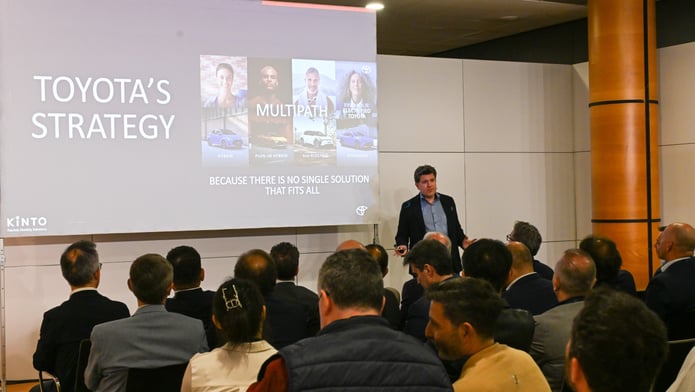
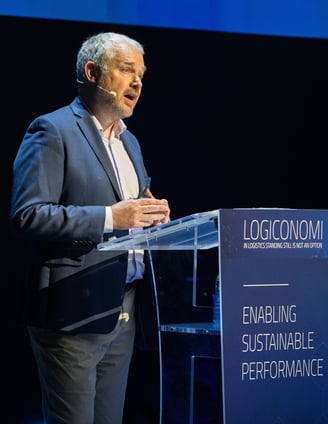 Robert Tickner, Head of Corporate and Product Communications at Toyota Motor Europe, explains: “Everybody wants to move towards sustainability, but not everyone can do it at the same pace. We need different solutions to help people evolve in a financially pragmatic way for both passenger cars and light commercial vehicles.”
This is where Toyota’s multi-path strategy comes in. “We’re developing several technologies,” he continues, “hybrid, plug-in hybrid, battery electric, fuel cell electric and even hydrogen combustion. Different customers, different environments, different needs.”
“The real enemy is not the technology; it’s CO₂ emissions,” Didier adds, “That’s why we combine the best mix of technologies and services, including carpooling and car sharing, to reduce emissions and optimise asset usage.”
This approach reflects the concept of technological pluralism—the idea that no single solution will dominate and that innovation must be context-sensitive.
Trust, agility and long-term vision
In a world of rapid change, resilience theory reminds us of the fact that adaptability and long-term thinking are not opposites, they are complementary.
“We’re all facing turbulent times,” Didier concludes, “We must act in an agile way but stay guided by a long-term vision. What never changes is the trust you need to build with your customers. And at Kinto we are leveraging a range of flexible mobility solutions to optimise the total cost of fleet operations and meet the expectations of our customers.”
This sentiment ties back to the broader sustainability narrative: whether it’s energy systems, warehouse automation or road transport, the path to a more sustainable future depends on collaboration, innovation and, ultimately, trust.
Enabling sustainable performance
Logiconomi is a communication platform, created by Toyota Material Handling Europe, to identify and understand challenges, trends and emerging technologies in the logistics industry. The aim is to support all players active in the logistics industry with insights and inspiration for improved logistics operations.
Discover more trends as we uncover more interviews in this blog series or in our latest trend report.